Showing posts with label marketing. Show all posts

Tuesday, 30 October 2012

3 Reasons Your Social Strategy is Failing, and what you can do to Fix it.

This article was originally written by Brad Smith for SocialMediaToday. You can go and read the original article by clicking here.


"Social tactics are not meaningful sales drivers", according to Forrester's latest research report.
They analyzed primary sales drivers for eCommerce, and concluded that less than 1% of buyers were from social visitors.
There's a few possible explanations for this.
The first (and most important) is that social aids the buying process indirectly, and is difficult to track -- which leads companies (and research firms) to under-appreciate and under-invest.
The second, is that most corporate social media strategies... simply aren't that good. And their results are mediocre because they're too tactical, and too focused on micro-decisions.
Here are 3 reasons why your social strategy is failing, and what to do instead.

Fix #1: Create Content, Not Updates

Every status update should have a purpose, and engineered to succeed.
You're not just "telling people what you're up to", but you're creating content with a specific objective, interesting hook, and call-to-action.
So every single status update should bear all the hallmarks of good content.
Research and dig into your prospect's psychology, use copywriting to intrigue and address their pain points, and monitor your analytics to do more of what people like, and less of what they don't.
Every status update should be like it's own advertisement:
  • Objective: At the end of the day, you need engagement or click-throughs. But emphasis one at a time, not both. Because if you want to maximize results, then you typically have to make a choice that will hurt the other option.
  • Headline:The first goal of your headline is to grab attention. The best way is to touch an emotional nerve, or reference a specific "world-view" they might have.
  • Description: The description is where you use copywriting to play on reader's interests and psychology, and get them to take action.
  • Image: Finally, the goal of your image is to produce a desired result. So it doesn't have to be explicitly tied to what you're talking about. Instead, make it sure captures attention and will make an emotional connection.
Here's an example of all those components coming together:
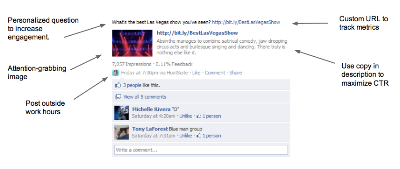
Becoming a social media publisher allows you to set the tone for engagement, and steer the conversation in ways that ultimately benefit you.

Fix #2: Create Assets, Not Followers

If you hope to profit from social media one day, then you need to do more then gain followers. 
Instead, you need to focus your marketing on one-to-many.
For example, partners and good relationships with other brands or influential properties are assets. If you can create enough of these, then you'll never have to worry about growing your followers again. Because they'll help you with promotion and drive awareness for years to come.
The same goes for your own in-house email list or blog.
These are platforms that grow in value, and allow you to freely share messages and instantly reach communities of people.
Invest in marketing assets first, and the social media mentions and friends will follow. 

Fix #3: Create Campaigns, Not Launches

Whenever a company has a new launch, promotion, or sale coming up, they want to start "marketing" on the opening day.
But by then, you've already lost.
Effectively promoting events or launches takes time, and can't happen overnight.
"If you want to succeed in social media, then think in quarters, not days." → [Click here to share this quote]
So tying in to #1 above, if you want to increase sales and engagement over the holidays, don't flood your social media channels with "Buy my widget now!" updates all day.
But start creating holiday content that teases and hints at upcoming promotions. Find partners to cross-promote and help you distribute this content. Then run contests to increase engagement and excitement for the upcoming holiday specials. Finally, use lead nurturing and email marketing to consistently follow-up with people when they do -- or don't -- show intent to buy.
Investing in a single, well planned and executed holiday campaign will always have a higher ROI than spamming people the day before Christmas.
And with one investment, you're getting multiple returns in brand awareness, new traffic, social media mentions & followers, high-quality links for SEO, new email leads, and of course -- more customers.
The key to social media isn't to reinvent the wheel.
The key is to take what's worked for years, and use social channels to distribute those messages farther, faster, and more effectively.

Thursday, 11 October 2012

Online Business for Starters

As a business owner, you plan to take your business into another level. You always dream of having several branches to reach more people, expansion is a bright idea but the cost may be too expensive. Now you can expand and share your service and product into a bigger market, why not take your business globally? 

Having an online business allows you to reach your target audience easily, communicating is faster and there is a great possibility to catch more clients. This is a cheaper way of expanding your business, hassle free and no need to build a new office. Sounds easy but how will you start? 

A business owner must know how to do internet marketing. If you are a busy person who doesn’t have time to take a short course regarding online business and internet marketing, you can simply take online coaching and training product which means you can learn in your own free time. It basically teaches how to leverage the internet marketing. It’s about making things easier and simpler, you do more and more with less and less. More profits, more income with less effort, less investment and less time. With this type of technique, a business owner can be rich in no time. 

Once you have an online business, it is important that you keep in touch with your visitors and turn them into a client. Follow - ups is necessary, through emails you can tell them directly about your service, it’s advantages and why they need it. Who knows, they might be interested with what you offer or refer you to other people. Why emails? Because millions of people go online and check their emails everyday. For starters, this can be complicated, there are a lot of things that need to be done and sending emails everyday can be tiring. No worries because there are companies that help starters in managing their business. 

Although some of them may be strict, not everyone can be accepted, they do this to protect their integrity. Applicants must be qualified or referred. Once accepted, they provide virtual office, complete with business tools, training and technical support. There are also business coaches who have a wide experience and vast knowledge when it comes to business. They will lead you to the road of success. This is specially designed to guide and help those who have an online business to become successful regardless of their education and background in business.

Monday, 10 September 2012

How to use Twitter Hashtags for your Business

This article was originally written by Stephanie Buck, for American Express Open Forums. Click here to read the original post.


Assuming you have a Twitteraccount dedicated to your small business, you should also be investing in hashtags as part of your social media strategy.
But let's back up a bit, in case you're unsure what a hashtag is. Designated by a number sign (#), the hashtag is paired with a word or phrase to perform a variety of functions. Twitter users attach hashtags to tweets as search mechanisms, categorizing tools and marketing tactics.
In your small business' case, you may choose to attach a hashtag, such as #smallbiz, or even your brand's name itself, as #nike might do. This improves the chance that other Twitter users will find your tweet in targeted Twitter searches. But hashtags also streamline your own processes. For instance, you may ask users to include a unique hashtag in their own tweets as part of your newest Twitter marketing campaign. Throughout your campaign, the hashtag files tweets for easy search and organization within Twitter.com.
Now that you're familiar with the basic hashtag concept, let's apply principles specific to small businesses. Follow these five tips to improve your brand's hashtag strategy.
1. Seek business-specific conversations. If you use Twitter for nothing else, use it to learn from others. Head to hashtags like #SMB or#smallbiz for advice, resources and current news of the small business variety (also follow along during Twitter chats). Although broad hashtags like these can generate an overwhelming number of tweets every day, tune in every so often for a quick update. A couple of scrolls down the feed could inspire your next blog post, marketing tactic or bestseller.
If you seek a more specific conversation, narrow hashtags down by topic. The #marketinghashtag contains a ton of small business-related content, as does #sales. Or take a peek in the#startups or #entrepreneurs hashtag for inspirational profiles in the space. Finally, if you're looking for tips on meeting like-minded businesspeople, try the #networking hashtag.
2. Keep it simple and consistent. When crafting hashtags for your own tweets, it's important to keep a couple rules of thumb in mind. First, keep your tags simple and direct. In a tweet about your latest blog post, which explains your company's use of finance apps, don't create a long, complex hashtag. Pair the tweet with hashtags like #apps and #SmallBiz, versus #SmallBusinessAppsandTools. Overly complicated hashtags like these are neither search-friendly nor commonly used, so your tweet will get buried quickly.
Secondly, don't weigh your tweets down with excessive hashtags. If your intention is to be thorough, a thoughtful, precise selection of 1-2 hashtags per tweet works. Seven hashtags reads like desperate marketing, and is a sure way to lose followers quickly.
3. Create your own hashtag. Hashtags are a great way to generate buzz around a marketing campaign. Domino's Pizza encouraged followers to tweet with #letsdolunch. Once the number of tweets reached 85,000, Domino's dropped prices by more than half during the hours of 11:00 a.m. and 3:00 p.m. that day.
Turn to Twitter when launching a contest, another great marketing tactic for your brand. Simply ask people to tweet with a specific hashtag when they submit ideas, jokes or photos. That way, when the entry period is over, you'll be able to easily locate submissions in one place.
Events are great opportunities for creating conversation around hashtags. Award your event a unique hashtag well before the actual date; you'll be able to generate content and discussion about the event before it even begins. (For example, Mashable created the hashtag #MashBash for one of our largest events ever, at CES 2012.) Then during the event, encourage participants to tweet with that hashtag with signage and other hashtagged swag. People in attendance both physically and via the web then will be able to follow interesting activities and discussion.
Finally, get creative. Use hashtags for Twitter chats and invite an industry expert to answer tweeted questions from your brand's followers. Or begin a game on Twitter using hashtags. For instance, ask people to tweet #PastTenseSitcoms, like "Family Mattered." It's a clever way to get people excited to connect with your hip, entertaining brand (we'd be remiss to not mention our own #Mashtags fun here).
4. Organize social dashboards by hashtag. One of the most convenient ways to stay on top of relevant hashtags is to designate easily accessible columns within your social dashboard. Whether you use HootSuite or TweetDeck, you can establish columns by social network, search term, Twitter list or hashtag.
Consider adding a small business-themed hashtag column to check whenever you have a moment. Add further columns as they become relevant, for example, when you launch a hashtag marketing campaign or contest. Then delete the column when the hashtag has run its course.
5. Take advantage of follow friday. In January 2009, Micah Baldwin announced on Twitter that he would suggest people to follow every week from then on. The Follow Friday trend soon took off with the hashtag #FollowFriday, but is now more commonly shortened to #FF.
You can craft a #FF of your own tweet in one of two ways. Create a list of people to follow and squeeze as many Twitter handles as you can into one tweet, with the hashtag #FF, of course. Make sure this list has a theme: are these the best foodies to follow? Political analysts? Activists? Comedians? Narrow down the type of people you're suggesting and indicate that in the tweet.
Some people choose to support only one or two people per #FF tweet, which is a more personal approach. You may consider crafting a tweet for a single person if you wish to compliment or communicate with that person, be it a journalist, executive or potential business partner.

Tuesday, 17 July 2012

Integrating and Using Social Media for your home Business

It's no secret that we're living and working in a digital age.

That's why it's vital that you utilise social media for your home business or company. We're already living in an age full of helpful technology and digital networking, and connecting with other people and businesses is easier than ever, thanks to the wonders of the internet.

Whether it be through Facebook, Google+ or Twitter; it's crucial to develop and maintain an online presence. Through a succerssful use and utilisation of Social Media, you'll find that not only will your customer or consumer base grow substantially, but the level at which you'll be able to develop and converse will feel much more personal, which is good for both the customer and you.

My business partner and I have recently started our own hlepful course teaching other small home businesses how to best utilise and grow through social media. All we need is your name and email address, and we will send you anything and everything you need to know.

You can sign up by clicking here.

Monday, 16 July 2012

Can Internet Marketing Be a Long Term Business?

Here is the basic honest truth: most of the people get into Internet Marketing because they are convinced it is an easy way to earn quick money. Their approach is to make a fast website, put up some advertising and a few affiliate links and then sit back and watch while they earn real cash. There are a large amount of individuals who do this and also earn lots of money on the internet. But what if you want more than some extra or even quick cash (quick cash, naturally being a misnomer)? Can Internet Marketing really be leveraged to produce a worthwhile and long term career? 

The quick and dirty answer is that yes, you are able to make Internet Marketing your long term and sustainable career. You only need to take on the project properly. The procedures and programs you use to build something to earn fast money are not all that different than the methods and systems you will use to build long term profits. So what would you do if you need to develop a sustainable career on the internet? 

It is very important that the first thing you do, in order to earn long term money online, is accept the fact that you are going to have to do real work. You will have to do actual and real work on a daily basis and you will have days when you feel fantastic about what you do and days when you wish you could find something else to take on. This causes it to be just about like every other occupation that is out there. If you want to produce lasting cash flow by working lots right now and not at all later on then you are going to be in for a rude awakening in a little while. So be ready to roll up your sleeves and get to work. 

There are a few ventures that lend themselves much better to a long term career than others will. Affiliate marketing, to use one example, is a great task for someone who wants to earn money on a part time basis or to supplement your already existent income. Is it truly possible to earn a full time income in this manner? You could if you pick out only the right products and then work like crazy to promote them. A far better approach, nevertheless, is to create your own products or websites and then promote those. This gives you full control over the projects you take on and how you accomplish them. And you will end up more likely to stick with it in the long run. If you want to give a service on the web this works much the same way. Writers, for example, need to create websites for themselves and create portfolios that they can point to as examples of their work. 

Finally, perhaps the most significant thing that you need to recognize is that, when you want to build a long term and reliable income on the internet, you need to truly dedicate yourself to your task. You might have fun and feel rewarded by your efforts but first you should tell yourself "yes, I really want to do this." Making a half hearted effort is not about to get you anywhere.

Tuesday, 3 July 2012

Should Your Small Business Advertise on Facebook?


Original Post from Mashable. Authored by Business News Daily

Conflicting reports have shown Facebook ads to be both an effective and ineffective means for businesses to target their advertising dollars. But despite those dueling findings, small businesses may not want to automatically write off advertising on Facebook, especially if it is done correctly and expectations are managed.
A report by Reuters/Ipsos which found that 80% of people said comments and advertisements on Facebook had not led them to make a purchase. On the other hand, a comScore report — which was co-sponsored by Facebook — showed that the ads did help purchases, sometimes as much as 38% over those not exposed to Facebook ads. Despite the different opinions in both those studies, they are both right… in a way.
BusinessNewsDaily spoke with several experts about what small business owners should know before deciding about whether or not to spend money on ads on Facebook.

Are Facebook Worth it for Small Businesses?

“It really depends. They definitely can be for some, but frequently aren’t for others,” said Tom Demers, co-founder and managing partner at Measured SEM, a search engine marketing firm. “One of the strongest uses for Facebook ads is to get people in a very specific demographic to like your Facebook page so that you can then message to them over time. For instance, if you’re a small local restaurant, you can get people in the area to like your page, and then when you do things like offer coupons or promote events, you can incentivize them to share those promotions so that their friends see it, which provides a unique viral effect you can’t with many forms of advertising.”
Viral ads, however, are not the only way that Facebook ads can help a small business, Demers said.
“Similarly, some small businesses can have success in promotion,” he said. “The businesses that often get poor results with Facebook ads are those that treat them like other advertising mediums and try to push hard to a sale. Facebook tends to work much better at promoting softer offers such as free giveaways, discounts or simply getting users to become fans of your business so that you can convert them into leads and sales down the line.”

What Benefits Do Facebook Ads Provide to Small Business Owners?

“Facebook ads build a list, just like email or direct mail marketing, but with much more control and data,” said Jason Keath, CEO and founder of Social Fresh, a social media education company. “Compare this to the yellow pages, radio, TV, print where you get the ad, but you do not get the list. With Facebook ads, business owners can create a growing community of potential customers that will be with them for years potentially.”
Simply put, Facebook ads, when used effectively, are able to benefit greatly from word-of-mouth advertising in a way that other ads cannot.
“On Facebook, you see other fans of a business or product. You see your friends like them. These things matter and make for more effective marketing,” Keath said. “Lastly, Facebook offers more options and data than any other online marketing channel. Ever. I can target an ad to editors that work at BusinessNewsDaily. I can target an ad at hiring managers for The New York Times. I can target people in my ZIP code that love BBQ. The options are endless. That gives a business access to marketing gold and relevance.”

How Effective Are Facebook Ads?

“First with Facebook, there is less competition for keywords than there is on Google or other pay-per-click sites,” said Tyler Barnett, founder and president of Tyler Barnett PR. “One of the biggest benefits for Facebook advertising is that you are reaching your target demographic in their comfort zone. When a person is logged into their Facebook page, they are comfortable. When they see your ad on their Facebook page there is a certain amount of trust that is inherent and that you don’t get when seeing a random link on a Google search.”
That trust can be a particularly important factor in the effectiveness of advertisements on Facebook, Barnett said.
“Typically with Facebook ads, you can go to the person’s Facebook page,” Barnett said. “The main difference between a Facebook page and a traditional web page is you can see customer feedback. If someone clicks on your Facebook ad and goes to your page, they can actually read what other people are saying about you. That helped build trust among your client base.”

How Much Do Facebook Ads Cost?

“Facebook ads can vary wildly in cost depending on who you’re trying to target,” Demers said. “Technically, the minimum bid for a click is a penny, and according to a Google AdWords] with other advertisers,” he said. “And you’ll frequently have to pay significantly more per click. As an advertiser you can also control how much you spend by setting daily and ‘lifetime’ budgets for campaigns.”
The price of Facebook ads is among their most appealing features.
“Facebook ads can cost as little as $10 a day and as much as you want,” Keath said. “We recommend a starting budget of $500 to $1,000 to get your feet wet. Test several ad types, images, landing pages with small investments of $10 a day. When you get it dialed in, pick your best performing ad and put a larger budget behind it.”
Barnett said small businesses should at least consider the option of Facebook ads because of their low cost.

Tuesday, 12 June 2012

A bit about how I Started - Marketing Internship

This is an age of tough competition where every company wants to make sure they outdo the competition and rise to the top. The most important factor that decides whether a company or enterprise will rise to the top is marketing. Marketing is one of the most coveted fields to day, getting precedence even over finance. Unlike finance, marketing is such a field which requires you to use your creativity and come up with your own ideas to promote the product or service offered by the company. The promotion of a product is the main factor which ensures its success. With the right promotion, a company can beat all the competition in the market and soar to the number one position. Sales marketing is an aspect of marketing which is related to the sales promotion of a product. This involves the inception of new ideas to promote a product so that it stands out among other similar products. 


Sales marketing is an emerging field which recruits youngsters readily in entry level or internship positions. If you are interested in sales marketing, then it is imperative that you get into an internship with a prominent company that will teach you all the ropes of the job. Marketing is more about aptitude that anything else. An internship lets you get the basic idea about exactly what a sales job entails. You can learn a lot in the few months that you spend as an intern and this experience will be valuable to you all your life. 


When you are getting into a marketing internship, there are several things that you should not do. Avoiding a few common mistakes will ensure that you go far in this field in the future. 


As a marketing intern, first things first, you need to be passionate about your work. A lack of enthusiasm and interest will create a bad impression that is virtually impossible to get rid of. The first thing that you are not to do is appear bored and interested with the work. 


At first you may find the job too stressful. Even if you are having trouble do not let on that you are having difficulties coping. Chances are that with time you will get used to working around the clock and will start enjoying your work. 


Being disorganized and scattered is a big no-no. When you start out as an intern you will be assigned to a project. Make your to-do list before hand and make sure that you completely all the tasks successfully. Forgetting something important or missing something obvious can be a major blunder. 


When you are assigned to a project do not set yourself unachievable goals. Unrealistic goals will hold you back, stressing you out and keep you from performing your very best. 


Do not miss deadlines. To be successful you need to work within your stipulated deadline. Meeting the target is one of the most vital aspects of a sales marketing job.

Friday, 8 June 2012

Social Media and Why it's Effective

Social media has established a prominent presence as form of marketing utilized by companies in countless industries worldwide. There are a variety of inherent factors that can prove to substantially increase a company’s brand equity and visibility, or possibly victimize a company’s reputation. The way in which a social media strategy is implemented and monitored can go a long way in determining its overall effectiveness. Today’s market features a wide array of consumers who have certain expectations of brands, products, and services. Discontented and social media savvy consumers are simply awaiting any opportunity to voice their opinions via Twitter, Facebook, and associated social channels. This makes it even more vital for a company to thoroughly research and consider what methods of social media are most appropriate and beneficial to their needs. 

There are a number of steps that can be taken in order to avoid the aforementioned social media disasters that occur frequently in today’s online marketplace. The first involves being realistic and properly understanding the relationship between conversations on social networks and other types of customer interactions. The next step includes utilizing a multi-channel strategy for customer sales and service. While social media is quite effective, interactions taking place at brick and mortar locations, on toll-free lines, and during online customer service chats are also very important in providing a comprehensive view of consumers’ opinions. The following step focuses upon viewing your data and evaluating the technology that is currently in place in order to understand consumer behavior and the voice of the customer. The final measure that can be taken to avoid social media disaster is to have a designated employee that specializes in the customer experience delivery chain. 

A company that does not currently possess a strong presence in social media does not have to fear making a huge investment in social media. There are a number of low cost options that can be practiced to make that initial leap into the realm of social media marketing. Starting a blog about relevant industry news, trends, or intriguing applications of your product line is an excellent way to embark into the world of social media. Creating a LinkedIn group, Facebook page, Twitter account, a customers-only discussion forum, or a YouTube channel can provide unique opportunities to present and inform users and fans alike of current company highlights and information. 

The key to a company’s successful use of social media is all about the results and the ability to properly measure them. Industry analysts are publicizing self-service business intelligence as the so-called “golden child” of 2011. In terms of marketing, one area that could widely benefit from self-service BI is social marketing. There are a number of best-practices that can be employed in order to measure social media effectiveness using BI solutions. Mapping out the ideal marketing process flow that will best transform prospects into quality sales leads is an exceptional starting point. Another practice involves determining the online marketing initiatives and campaigns that will be implemented to attract and engage prospects. Selection of the appropriate outlets to use is quite important in safeguarding the effectiveness of these initiatives. 

Each initiative that comprises the marketing plan must then have a pre-established audience profile, outreach, value proposition, and budget that you are willing to spend. The most appropriate set of keywords must then be identified to ensure optimal website content that is designed for those specific keywords. Identifying and adjusting paths on social networks, aligning the website experience with specific landing pages, and setting goals for desired actions are all best-practice techniques in order to ensure continuity. It is also vital to measure all of the initiatives that are being used at a given time to display your activity, outreach, engagement, and outcomes. An even more thorough approach includes tracking all the way through to incremental sales, revenue and gross profit that is derived directly from online marketing. Business intelligence allows insight at the appropriate times during your social media campaigns. It offers the ability to instantly alter campaign focus and direction. Social media marketing can greatly benefit from the use of business intelligence as marketers can produce and exhibit greater value in their social media outreach campaigns.