Thursday, 22 November 2012

Free and Open Campaign


At the start of 2012, many internet companies and brands teamed up to fight against web censorship, in the forms of the SOPA (stop online piracy act) and PIPA (protect IP act) bill. It worked very well, but now a new threat looms over the free internet. And it's headed by the UN.
In December, nations around the world will be meeting in Dubai to discuss proposed changes to how the Internet is operated. Currently, much of the Internet is operated by ICANN, a neutral NGO. Some nations in the UN want to transfer its power to the ITU so that member nations in the UN can have more of a say in how the Internet works.
Open Web proponents immediately decried the idea, and the US has been investigating the potential harm such a change would cause. For their part, Google has started another “Take Action” campaign that asks citizens from around the world to demand a free and open Internet.
Going off of precedent alone, Google may very well be successful with its latest campaign. The search giant, along with other Internet companies, were instrumental in mobilizing US citizens against SOPA and PIPA in January.
Of course, there are some key differences between the SOPA blackout and now that could swing the campaign in either direction. For one, trusted brands and companies like Google, Facebook and Wikipedia all came out against the legislation with blackouts and other extreme visual messages. The proposed changes in the UN have had no such campaign yet, and prolific Internet figures like Mark Zuckerberg and Jimmy Wales have yet to issue strong statements against it.
Google’s campaign, however, could make all the difference. The company could inspire the same amount of fervor if it were to lay a doodle over its homepage again. The company hasn’t done that just yet, but we could see more action on the part of Google as we move closer to the UN gathering.

Thursday, 8 November 2012


If you use Facebook as a tool for promoting your business or brand, then you have probably noticed that Facebook has recently updated its EdgeRank, also known as its News Feed Algorithm.
Facebook is not trying to hide the fact that they want businesses to start paying to promote their posts. It is in Facebook's best interests if your posts are not showing up in people's newsfeeds. They want you to pay to have your posts appear there.
You might wonder if there is any hope in getting your posts noticed in Facebook's newsfeeds without having to pay to promote them. While it is not possible to have your posts appear to everyone who has "liked" your page (even if you pay to promote them), it is possible to improve your chances of having your posts noticed by keeping these tips in mind.
Keep Your Fans Coming Back for More
Many people post whatever comes into their head on Facebook, even on their business pages. Before you post, ask yourself if this is something that your fans would really be interested in seeing. The more posts your fans ignore, the less likely it is that your future posts will appear in their newsfeeds. Many people who "like" a page on Facebook never visit the page again. To get people coming back to your page, your content must be truly engaging.
Remember that negative interaction with your fans can actually count against you. If your fans think you are spamming them they can report your posts to Facebook, further reducing your chances of your future posts being seen.
So how do you get your Facebook fans to interact with your business page? First let's look at what Facebook's EdgeRank algorithm is measuring.
Facebook's EdgeRank Algorithm
EdgeRank takes into consideration how much you interact with your fans. The more interaction the better, especially if your fans are actively interacting with you by "liking" and commenting on your posts.
The EdgeRank algorithm also looks at what type of interaction your fans are having with your page. It gives greater weight to comments than "likes", and the more comments the better.
The algorithm looks at how long ago a post was created. The more recent the post, the more weight it is given.
It is important to remember that the more fans you have the better. If you have a big fan base and are showing ongoing interaction with your fans, the EdgeRank algorithm gives more weight to your Facebook updates.
Create Engaging Content
Before you post on your Facebook page, ask yourself what your fans would like to see. It is easy to fill your page with links to your web site or blog, which is not necessarily bad, but if your fans are not interacting with your posts, think about how you can vary or improve your content to generate more interest.
Images have been shown to create more fan engagement than just text links. People like to look at photos, and if you post some interesting pictures that people can relate to, they will be much more likely to leave a comment.
One of the most effective ways to get people to respond is to ask a question. Try to think of questions that many people can relate to. People like to talk about themselves, so ask a question that will get them talking about what is important to them. Their responses may just give you some ideas for new posts or articles.
When people do leave comments on your page, make sure to respond to their comments. Show your fans that you care about their thoughts and that you will respond to their questions and comments.
Contests and giveaways are also effective ways to increase fan engagement on your Facebook page. People always love to win things, and they will keep checking your page to see if they have won.
Time Posts to Increase User Engagement
Remember that most people are not logged into Facebook all day. Try to time your posts to the times of day when people are most likely to be checking their newsfeeds, such as first thing in the morning, at lunch time, and after dinner.
Unfortunately, there is no way to completely understand Facebook's EdgeRank algorithm. Facebook is slowly moving toward a pay-to-play model and business owners will either have to adapt to the new model or find another way to promote their businesses. Don't forget that creating useful, engaging content, however, will go a long way toward getting your posts viewed by more of your Facebook fans. 

Tuesday, 30 October 2012

3 Reasons Your Social Strategy is Failing, and what you can do to Fix it.

This article was originally written by Brad Smith for SocialMediaToday. You can go and read the original article by clicking here.


"Social tactics are not meaningful sales drivers", according to Forrester's latest research report.
They analyzed primary sales drivers for eCommerce, and concluded that less than 1% of buyers were from social visitors.
There's a few possible explanations for this.
The first (and most important) is that social aids the buying process indirectly, and is difficult to track -- which leads companies (and research firms) to under-appreciate and under-invest.
The second, is that most corporate social media strategies... simply aren't that good. And their results are mediocre because they're too tactical, and too focused on micro-decisions.
Here are 3 reasons why your social strategy is failing, and what to do instead.

Fix #1: Create Content, Not Updates

Every status update should have a purpose, and engineered to succeed.
You're not just "telling people what you're up to", but you're creating content with a specific objective, interesting hook, and call-to-action.
So every single status update should bear all the hallmarks of good content.
Research and dig into your prospect's psychology, use copywriting to intrigue and address their pain points, and monitor your analytics to do more of what people like, and less of what they don't.
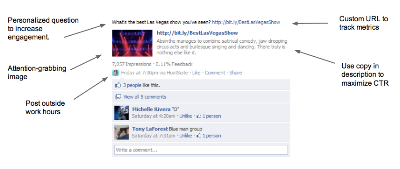
Every status update should be like it's own advertisement:
  • Objective: At the end of the day, you need engagement or click-throughs. But emphasis one at a time, not both. Because if you want to maximize results, then you typically have to make a choice that will hurt the other option.
  • Headline:The first goal of your headline is to grab attention. The best way is to touch an emotional nerve, or reference a specific "world-view" they might have.
  • Description: The description is where you use copywriting to play on reader's interests and psychology, and get them to take action.
  • Image: Finally, the goal of your image is to produce a desired result. So it doesn't have to be explicitly tied to what you're talking about. Instead, make it sure captures attention and will make an emotional connection.
Here's an example of all those components coming together:
Becoming a social media publisher allows you to set the tone for engagement, and steer the conversation in ways that ultimately benefit you.

Fix #2: Create Assets, Not Followers

If you hope to profit from social media one day, then you need to do more then gain followers. 
Instead, you need to focus your marketing on one-to-many.
For example, partners and good relationships with other brands or influential properties are assets. If you can create enough of these, then you'll never have to worry about growing your followers again. Because they'll help you with promotion and drive awareness for years to come.
The same goes for your own in-house email list or blog.
These are platforms that grow in value, and allow you to freely share messages and instantly reach communities of people.
Invest in marketing assets first, and the social media mentions and friends will follow. 

Fix #3: Create Campaigns, Not Launches

Whenever a company has a new launch, promotion, or sale coming up, they want to start "marketing" on the opening day.
But by then, you've already lost.
Effectively promoting events or launches takes time, and can't happen overnight.
"If you want to succeed in social media, then think in quarters, not days." → [Click here to share this quote]
So tying in to #1 above, if you want to increase sales and engagement over the holidays, don't flood your social media channels with "Buy my widget now!" updates all day.
But start creating holiday content that teases and hints at upcoming promotions. Find partners to cross-promote and help you distribute this content. Then run contests to increase engagement and excitement for the upcoming holiday specials. Finally, use lead nurturing and email marketing to consistently follow-up with people when they do -- or don't -- show intent to buy.
Investing in a single, well planned and executed holiday campaign will always have a higher ROI than spamming people the day before Christmas.
And with one investment, you're getting multiple returns in brand awareness, new traffic, social media mentions & followers, high-quality links for SEO, new email leads, and of course -- more customers.
The key to social media isn't to reinvent the wheel.
The key is to take what's worked for years, and use social channels to distribute those messages farther, faster, and more effectively.